
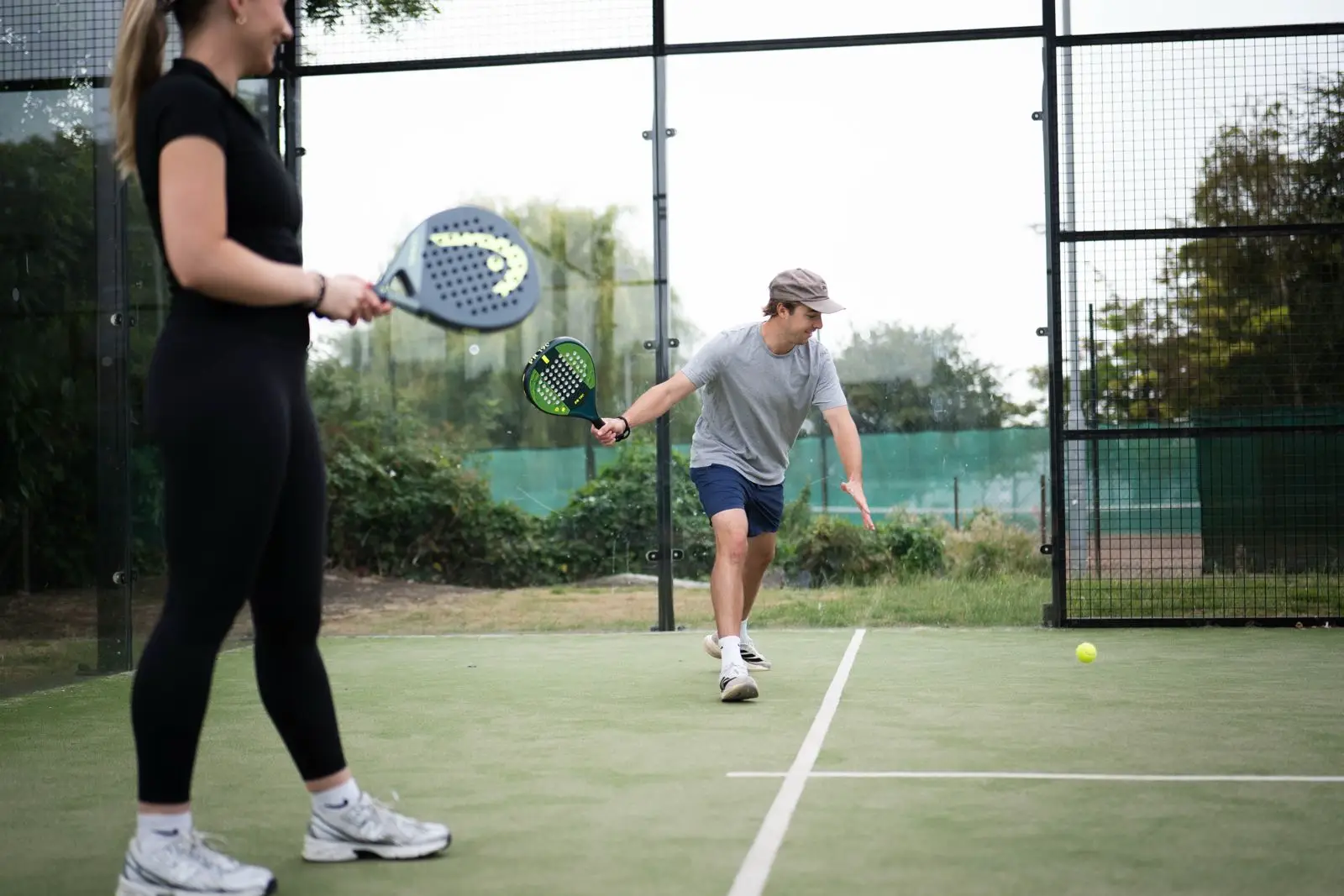
If you’d told most people in Wales five years ago that they’d soon be spending their evenings standing inside a glass box, holding what looks like a swing ball bat and arguing about whether the ball hit the back wall first, you probably wouldn’t have got much sense out of them.
Yet here we are.
Padel has gone from a relatively unknown racquet sport to one of the fastest-growing sports in Britain in just a few short years. Courts are appearing across the country, group chats are filling up with people looking for a fourth player and plenty of us who try it for the first time quickly find ourselves wondering when we can play next.
But despite feeling like a very new sport in the UK, padel has actually been around for more than half a century.
And its story starts a long way from Wales.
It all started in a back garden
Padel was born in Acapulco, Mexico, in 1969 – and not as part of some grand plan to create a global sport. Enrique Corcuera wanted somewhere to play at his holiday home but didn’t have enough space for a conventional tennis court. So he improvised.
He created a smaller court surrounded by walls and developed a game that incorporated those walls rather than treating them as an inconvenience. The result was the basic version of the sport we play today.
It is predominantly played as doubles, with an underarm serve and solid, stringless rackets. Crucially, the walls are in play.
That last part changed everything.
Rather than a point necessarily ending when the ball passed you, it could rebound off the glass and come back into play. Suddenly there was another dimension to this racquet sport.
According to the BBC’s history of the game, padel made its way to Spain in 1974 when Prince Alfonso de Hohenlohe, having discovered it in Mexico, built two courts in Marbella and that’s where things really started moving.
Spain caught the padel bug
If you’ve spent much time in Spain recently, you’ll know padel isn’t some niche new activity there.
It’s everywhere.
Clubs, hotels, leisure centres and residential developments have courts. Friends meet for a game after work. Families play together. Competitive players take it incredibly seriously, while plenty of others are just there for a hit and a beer afterwards.
By 2022, the BBC reported that Spain had around 20,000 padel courts. That popularity is important to understanding why padel is now growing so quickly elsewhere.
Spain effectively showed that padel didn’t have to sit in the shadow of tennis. It could develop its own culture and that culture is noticeably more social.
Most importantly, you don’t have to be particularly good to enjoy yourself.
Easy to start. Very difficult to master.
This might be padel’s secret weapon.
Tennis is brilliant, but it can have a fairly unforgiving learning curve. If four complete beginners walk onto a tennis court, there might be quite a lot of ball collecting involved.
Padel tends to give you something back much sooner.
The smaller court, slower ball, underarm serve and surrounding walls make it easier for beginners to get rallies going. Within your first session, you can normally start having something that resembles a proper game.
That’s part of the appeal. The entry point is low, but the ceiling is incredibly high. Positioning, patience, angles, defending off the glass, knowing when not to smash the ball – there is always something else to learn.
Viviana Corcuera, who helped create the original game with her husband, told the BBC that one of padel’s strengths was that people needed very little time to start rallying, while mastering the sport required technique, strategy and athleticism.
That combination has proved pretty powerful.
Then Britain discovered it
For years, anyone who played padel on holiday in Spain would come home and face one fairly significant problem:
Where on earth do you play it here?
That is changing very quickly.
When the LTA took over governance of padel in Britain in 2019, there were just 68 courts.
By the end of 2025, the LTA recorded 1,553 courts across 559 venues, while 860,000 adults and juniors had played padel at least once during the year. That’s up from 400,000 players in 2024, 129,000 in 2023 and just 15,000 in 2019.
So, what happens next?
For us at CWRT, that’s the exciting bit.
We’re not trying to reinvent a sport that has already travelled from Mexico to Spain, across Europe and throughout Britain. We just want to help write the Welsh chapter.
Make it accessible. Make it social. Make it competitive when people want competition and relaxed when they don’t. Most importantly, build somewhere people actually want to spend their time.
After all, padel has always been about more than hitting a ball over a net.
It’s four people, one cwrt, and a reason to get together.
See you on cwrt.